

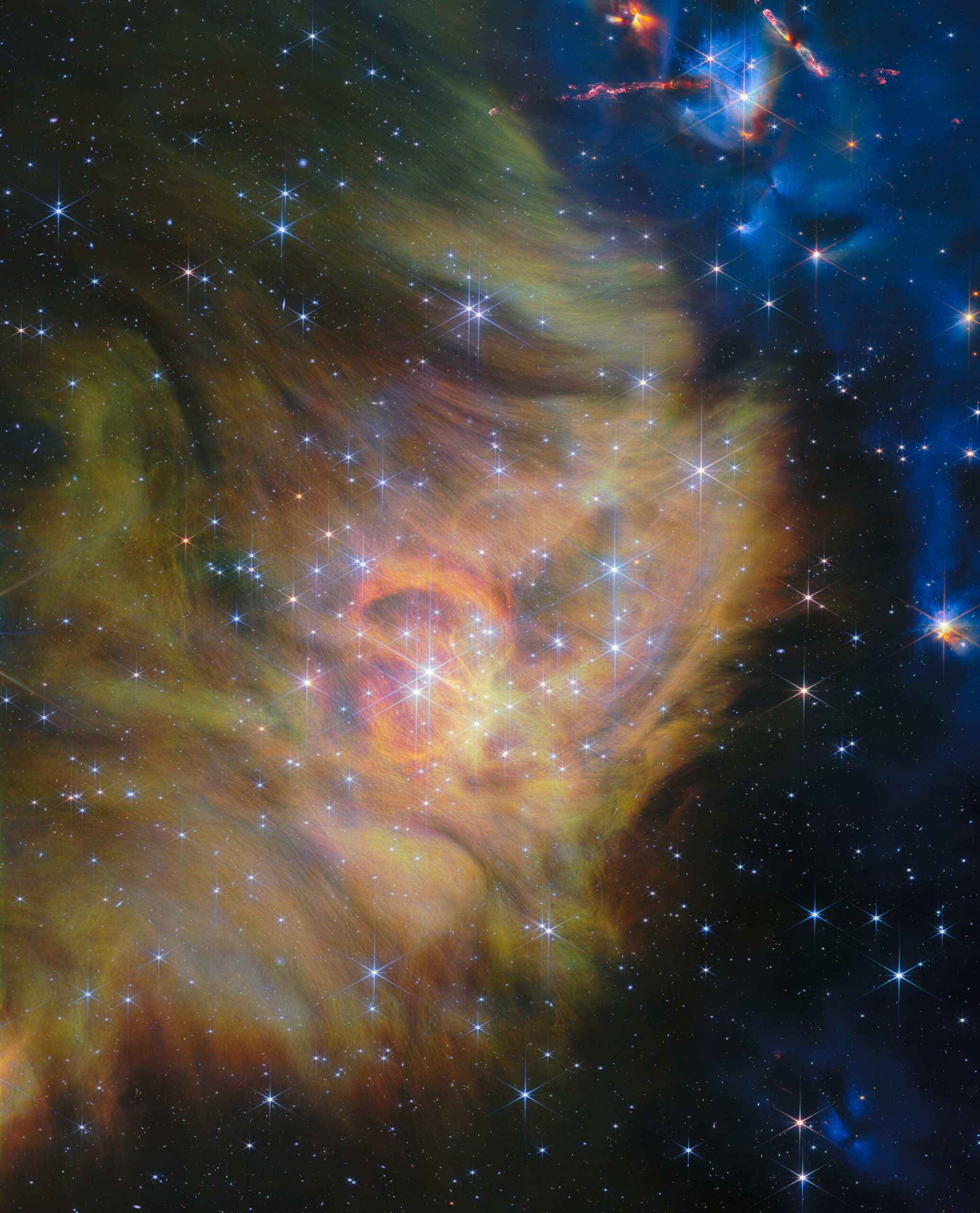
Something very unusual is forming about 1,000 light-years away from Earth in a cloud of gas and dust in the constellation Perseus. NASA’s James Webb Space Telescope is peering into a young stellar nursery, IC 348, where stars are still being born. What it found was infinitely smaller than expected. Some of the brown dwarfs hiding there are about twice the mass of Jupiter, leading scientists into territory where the line between a planet and a star becomes difficult to define.
Webb finds brown dwarfs twice the mass of Jupiter
Brown dwarfs have always been awkward objects in astronomy. They form in much the same way as stars do from collapsing clouds of molecular gas under gravity’s pull, but they never grow big enough for their centers to sustain the hydrogen fusion that makes normal stars shine.
Astronomers had previously found brown dwarfs several times the mass of Jupiter in IC 348. But this time the telescope reached farther. They used Webb’s near-infrared camera, known as the NIRCam instrument, to look for faint young objects in the region based on their colours and brightness in 2024. Webb’s NIRSpec instrument was then used in 2025 to further look at the most intriguing objects for closer examination.
What they discovered was new and possibly makes us question what we know about stars, how they formed, and their link with planet formation. Webb detected brown dwarfs containing only about twice the mass of Jupiter. They are dwarfs with the least mass ever identified, pushing the limits of what astronomers thought impossible for an object formed through a star-like process.
The discovery gets even weirder when Webb looks closer.
One of the smallest brown dwarfs seems to have a disk around it. That’s significant because disks of gas and dust are closely connected to the process of planet formation. Thus, astronomers might be looking at something the size of a star that might itself contain the raw materials needed to make planets. What a wonderful possibility. Imagine a cosmic nursery where stars are born, but also objects slightly more massive than planets, and at least one may even have its own planetary system forming.
According to the European Space Agency (ESA), the finding is evidence that planets could be forming around a brown dwarf that is itself only about twice the mass of Jupiter. The research team discovered a hydrocarbon feature in the atmospheres which has only been seen in the lowest-mass brown dwarfs, suggesting the possibility that these objects could belong to an unusual spectral class of their own.
Not just a bunch of sparkly objects
The Webb image also shows new information we have not been able to previously discover. The technology of today has revealed luminous objects that are created when powerful jets from young stars blast into the gas and dust surrounding them. What looks like a beautiful cloud of glowing gas is a beautiful array where brown dwarfs, stars and even planets are being born simultaneously.
That’s why the new Webb observations are so critical. We are testing our understanding of where the boundary between stars and planets really is. A stellar nursery has revealed a nursery within a nursery, where tiny brown dwarfs may be surrounded by the ingredients to form planets and Webb has only just begun to reveal wat is hiding inside. Perhaps the most intriguing thought is that the universe is way beyond our current understanding.

Leave a Reply