

Business networking is often presented as one of the best ways to grow a business. Meet new people, exchange contacts, share opportunities, and build relationships that could eventually lead to new clients.
Durban has no shortage of networking opportunities, from coffee mornings and business breakfasts to structured referral groups.
But is every networking group genuinely interested in supporting its members? And when does networking become more about business transactions than building relationships?
A recent experience prompted me to look at the less comfortable side of business networking.
When ideas are copied?
After joining a local networking group in the Upper Highway area, I contacted the organiser with an offer to contribute to an upcoming meeting.
I suggested giving a short, complimentary talk. I also offered a feature in my digital magazine to give additional exposure.
The offer was made voluntarily, with no expectation of payment or promotion in return.
There was no response.
A few weeks later, an announcement appeared on the group’s social media page introducing a representative from another magazine who would be attending an upcoming meeting to learn more about the group and its member businesses.
The timing caught my attention. I had suggested a business talk and offered magazine exposure, only to see another publication being introduced to the same business community shortly afterwards, and guess what was on offer… A short complimentary talk and a feature in a magazine (nope, not mine)…

I questioned the organiser about this.
I found it highly inappropriate and unethical to copy my exact idea and give it to someone else.
The convenient response was that the arrangement with the other magazine representative had been made before my October meeting and that the representative was simply attending to learn about the group, not to give a talk or offer advertising.
However, the explanation did little to address my concerns. My original offer went unanswered, yet they later announced a seemingly similar opportunity with another publication.
I was expected to accept that the two arrangements were entirely unrelated, despite the timing and similarities.
Perhaps the most disappointing aspect was the lack of communication in the first place. A simple acknowledgement, even if the offer was declined, would have been professional courtesy.
It raises a bigger question: how do networking groups handle the ideas, contributions, and goodwill of the very people they invite into their business communities?
I had no choice but to leave this group and part ways. I have no proof; I could ask for these emails to prove their innocence, but they have revealed who they are, and that does not align with my business practices, so I just walk away. But how many others won’t? How many just accept this type of behaviour and leave it unchecked?
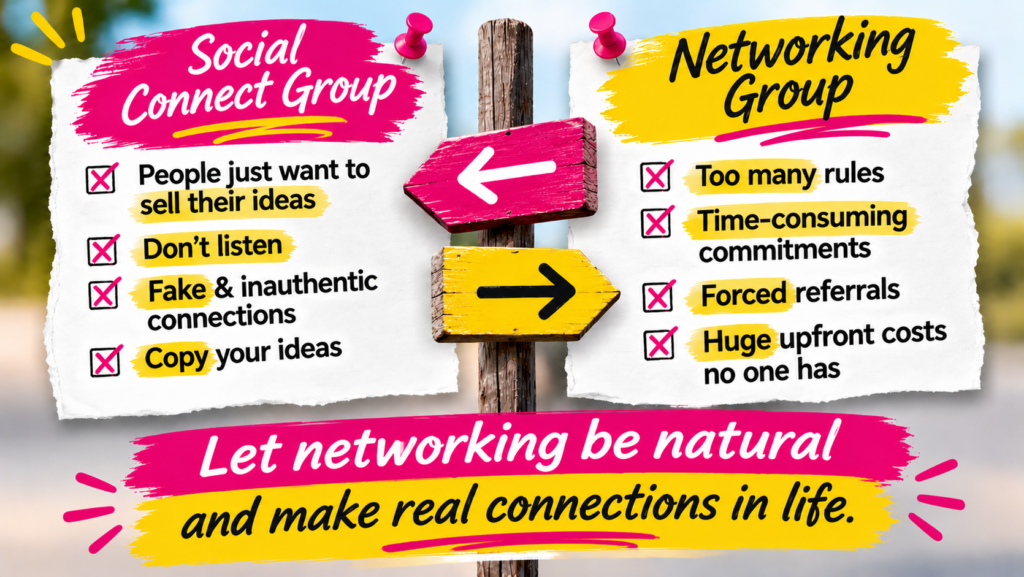
Now, this group is just a social connect group without many rules, but what about the network groups with too many rules?
Forced referral systems
Referral-based networking can work extremely well. A genuine recommendation from someone who knows and trusts a business can be incredibly valuable.
But there is a difference between recommending a business because you believe in its service and doing so because you are expected to meet a referral target.
Some structured networking organisations have attendance requirements, visitor targets and expectations around generating referrals for fellow members.
For example, some network groups publish membership policies outlining member participation and referral expectations.
A structured referral system isn’t automatically unethical when it clearly explains its requirements and members willingly participate.
The problem arises when people feel pressured to recommend businesses they have never used, cannot personally vouch for, or would not ordinarily refer to their own clients.
Every recommendation you make is tied to your professional reputation.
A referral should be based on trust, not obligation. Let networking be natural and make real connections in life that align with you.
Red flags to watch out for
Before joining a networking group, consider asking a few questions:
- Referral expectations: Are you expected to provide a certain number of referrals or bring visitors?
- Membership costs: What exactly do you receive in return for your time and money?
- Free contributions: Are members expected to provide prizes, marketing, expertise, or promotional support?
- Speaking opportunities: How are speakers and business features selected?
- Transparency: Are sponsorships, partnerships, and promotional opportunities clearly communicated?
- Communication: Are questions and suggestions acknowledged, even when the answer is no?
- Mutual support: Does the group genuinely support its members, or is the expectation largely that those members support the group?
A networking group should welcome questions. You should never feel pressured to compromise your professional judgement simply to remain part of a community. a Networking group should give you
What genuine networking should look like
Good networking is about building relationships over time.
It is about meeting people, understanding what they do, sharing knowledge and identifying opportunities where businesses can genuinely help one another.
Not every introduction needs to produce a sale, nor every meeting needs to generate a referral.
You have to ask yourself if this networking group will genuinely be the right fit for every business. Or is it a bunch of people with hobbies and side hustles? Because let’s face it, if you a real entrepreneur, you don’t have time to eat and sleep, let alone attend tea parties and listen to 5 people who do marketing, a reiki healer, an aspiring author, and, of course, the life coaches.
Nothing wrong with any of those professions. (I am listed among them.) But if your objective is to grow a business, you need more than a room full of business cards and introductions.
Organisers should be transparent about their expectations, acknowledge contributions and treat members with professional courtesy.
Business owners, in turn, should understand what they are committing to before offering their time, resources, contacts or platforms.
Know your worth
As small business owners, we invest considerable time and money in building our reputations. Our knowledge, ideas, audiences and professional relationships have value.
Networking should create opportunities, not obligations. It should encourage collaboration, not competition for visibility or pressure to generate business for others.
There is nothing wrong with walking away from a group that does not align with your values.
Sometimes the most important business connection you make is recognising where you do not belong.
Because genuine networking starts with mutual respect.

Leave a Reply